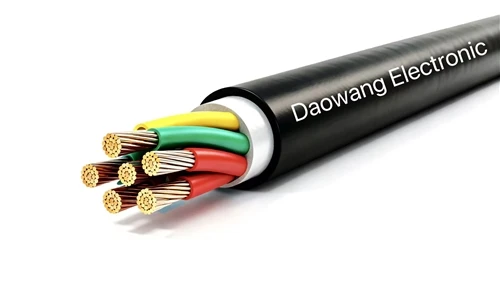
1.Understand the Basics: What are FLRY series wires?
Before comparing FLRY-A with FLRY-B, we must first clarify the "identity positioning" of the FLRY series. FLRY is a standard for special wires for automobiles and low-voltage electrical systems formulated by the International Electrotechnical Commission (IEC), with the full name "IEC 60317-11". It mainly stipulates the technical parameters, material requirements, temperature and weather resistance, etc. of insulated flexible wires.
The core feature of this type of wire is "soft insulation + suitable for mobile/vibration scenarios", and thus it is widely used in:
-
Automotive wiring harnesses (such as engine compartment, interior circuits, and headlight circuits)
-
Small industrial equipment (such as machine tool control circuits, internal wiring of medical devices)
-
Fields such as ships and rail transit that have requirements for the flexibility and weather resistance of wires

FLRY-A and FLRY-B are the two most commonly used sub-models in this series. The differences between them may seem subtle, but they directly determine the boundaries of the applicable scenarios.
2.Core difference comparison: What exactly are the differences between FlY-A and FlY-B?
Many people mistakenly believe that FLRY-A and FLRY-B are merely the difference between an "upgraded version" and a "basic version", but that is not the case. Let's break it down clearly with a table:
| Comparison dimension | FLRY-A | FLRY-B |
| Oil resistance/chemical resistance | It can come into contact with automotive lubricating oil and brake fluid | It is not recommended to be in long-term contact with oil stains |
| Flexibility | It has medium flexibility and is suitable for fixed wiring or scenarios with a small amount of movement | It has better flexibility and can adapt to environments with slight vibration and frequent bending |
| Applicable to core scenarios |
High-temperature and oily environments (such as engine compartments of automobiles and high-temperature areas of industrial equipment) |
Scenarios that are at normal temperature, dry, and require frequent bending (such as automotive interior circuits and equipment control panels) |
There is no absolute "superiority or inferiority" between the two; there is only a difference in "scene adaptability" - for instance, when FLY-B is used in the engine compartment, it may cause the insulation layer to age and crack due to high temperatures. If FLRY-A is used in the door wiring harness that needs to be bent frequently, it may cause wire breakage due to insufficient flexibility.
3.Precautions for use: You must choose the right one and use it correctly
Even if FLRY-A or FLRY-B is selected correctly, improper installation and use may still lead to circuit faults. Here are two details that are often overlooked:
Avoid exceeding the specified current carrying capacity
Both FLRY-A and FLRY-B have a clear "rated current carrying capacity" (for example, the rated current carrying capacity of a 1.5mm² FLRY-A is approximately 10A). If a current exceeding the rated value is forcibly passed through, it will cause the wire to heat up and accelerate the aging of the insulation layer. For example, if a 1.0mm² FLY-B is used to power high-power car lamps, it may cause the circuit to overheat due to overload, or even short circuit.
Pay attention to "environment adaptation" during installation
When using FLRY-A, avoid repeated bending: Although it is heat-resistant, its flexibility is average, and frequent bending can cause the conductor to break. When using FLY-B, keep away from high-temperature sources: Even short-term high temperatures may cause the PVC insulation layer to deform. It is recommended to maintain a distance of at least 5cm from high-temperature components such as engine exhaust pipes and heating plates.

4.Summary: Between FLRY-A and FLRY-B, choosing the right scenario is the key
To sum up the selection logic of the two in one sentence: "Choose A for high-temperature oil stains and B for normal-temperature bending."
FLRY-A is the "guardian of high-temperature environments", suitable for withstanding harsh conditions such as high and low temperatures and oil contamination. FLRY-B is the "all-rounder of flexible wiring", suitable for circuits that need to be bent frequently at normal temperature. No matter which one is chosen, the core is "to make the performance advantages of the wires match the scene requirements" - after all, there is no best wire, only the most suitable wiring solution.