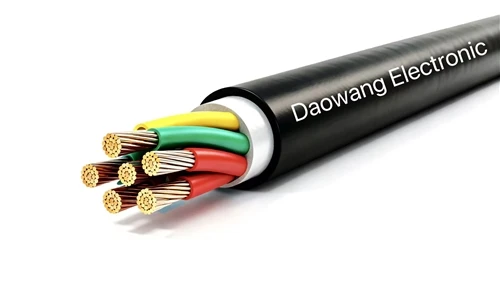
The choice of cable is important in electronic equipment internal wiring, industrial automation control and data signal transmission. UL20276 is a common UL-certified multi-core signal cable used in many electronic devices and control systems, thanks to its lightweight, flexibility and safety standard compliance.
What is a UL20276 cable?
UL20276 is a multi-core cable style within the UL 758 Appliance Wiring Material (AWM) series. Multi-conductor cable with extruded, non-integral sheath. Generally rated 30V, with temperature rating of 60 or 80 degrees C. It has met the UL VW-1 vertical burning test, proving good flame retardant properties. CONDUCTORS are generally of tinned copper. The insulation and sheath are generally of PVC. Some have optional aluminum-foil shielding, braided shielding or twisted-pair shielding.
UL20276 may be constructed with two or more insulated conductors twisted in pairs or bundled in groups in parallel. The sheath is PVC, extruded, with optional shielding. It is RoHS and other environmental compliant and suitable for internal wiring or external interconnection of electronic equipment in Class 2 circuits. Typical construction Tinned copper conductors PVC insulation Aluminum-plastic composite tape + tinned copper braided shielding (optional) PVC outer sheath The bending radius is usually 6-10 times (fixed) or 8-20 times (moving) the diameter of the cable.
Main application scenarios of UL20276
UL20276's low voltage and multi-core flexibility make it particularly suitable for signal and control applications, rather than high-power power transmission.
Key applications include:
-
Internal wiring for electronic equipment: Computers, peripherals, laptops, LCD/LED display cables, scanner cables, etc. The multi-core structure allows for the simultaneous transmission of multiple signals, saving space.
-
Data and signal transmission: Data cables in machine and switchgear systems, especially where high near-end crosstalk attenuation is required. Twisted-pair + individual foil shielded versions are suitable for higher data transmission rates.
-
Industrial automation and robotics: Moving parts in factory automation (FA), robot cables, cable carrier systems. Some highly flexible versions can withstand 50 million to 100 million bend tests.
-
Control and monitoring systems: Intelligent control circuits, temperature control equipment, HVAC control systems, security monitoring systems, office automation, and internal wiring for home appliances.
-
Compensates misalignment and deflections
-
Others: Measuring and testing equipment, internal interconnection of complete equipment systems.

In these applications, the cables are often used in dry or humid indoor environments, either fixed or with limited mobility. Its 30V rated voltage clearly limits its use in high-power applications.
Comparison of UL20276 and single-core wire
Single-core wire (single-core insulated conductor) typically refers to a single solid or stranded conductor covered with an insulation layer, without an integral sheath or multi-core integrated. Common examples include AWM single-core wires such as UL1007 and UL1015, with rated voltages mostly at 300V or 600V, suitable for power or fixed wiring. UL20276, on the other hand, is a typical multi-core sheathed cable. The two differ significantly in structure, performance, and application.
The following table compares key dimensions:
| Comparison Projects | UL20276 multi-core cable | Single-core cable (typical AWM single-core) |
| Structure | Multiple insulated conductors + optional shielding + overall PVC sheath | Single conductor + insulation layer, no overall sheath |
| Flexibility | High (multi-core stranded, suitable for bending and movable parts) | Lower (solid is harder, has slightly better interlocking, and is suitable for fixing). |
| Voltage/Temperature |
30V,60/80°C |
Common 300V/600V, 80-105°C or higher |
| Current capacity | Lower (for signal/control purposes, with a small single-core cross-section | Higher (more suitable for power transmission under the same cross-section) |
| Anti-interference | Optional twisted pair + foil/braided shielding, with excellent EMI performance | It is usually unshielded and requires additional processing |
| Installation convenience |
One cable for multiple signals saves space and wiring time |
Multiple circuits require multiple wires, making the wiring complex, but the heat dissipation is better |
| Typical application | Electronic internal signals, data, control, drag chains | Fixed power wiring, high-current connections inside the panel |
| Cost | Relatively high (multi-core + sheath process) | Relatively low |
As we can see from the comparison, single-core wires have the advantages of strong current carrying capacity and fixed installation, good heat dissipation and low cost, which are suitable for long-distance power or high current use. But, if you need to transmit multiple signals at the same time, or space is at a premium, or you need to bend the cable, or you need to shield it from interference, then multi-core cables, such as those covered by UL20276, clearly come out on top. Single-core wires used for multiple signals require extra bundling and shielding, which adds complexity and more potential points of failure. Multi-core cables provide a common solution, with efficiency advantages, especially in automated equipment and consumer electronics.
Selection suggestions and precautions

When selecting UL20276, it is necessary to confirm the specific AWG specification, core count, whether shielding is required, temperature rating, and whether a high-flexibility cable chain version is needed. Note its 30V limitation; it must never be used in main power circuits. During installation, adhere to the bending radius and avoid excessive stretching. When using it with single-core wire, ensure overall system voltage matching and grounding/shielding.
In actual projects, if the cabling is primarily for signal control and space is limited, UL20276 is preferred; if power transmission or fixed high-current applications are the primary focus, single-core wire is more suitable. Our factory offers customized core count and shielding options to meet specific EMC requirements.
Summary
UL20276 is a mature 30V multi-core signal cable with UL certification and VW-1 flame retardancy, flexible structure and optional shielding, playing a vital role in electronic equipment wiring, data transmission and industrial automation control. It is better than single-core cables for multi-signal integration and mobile applications but better for fixed power applications single-core cables. The proper selection enhances the reliability of the system, optimizes the wiring and meets the safety and environmental compliance requirements. In practical application, it is recommended to refer to the manufacturer's datasheet and check the cable according to the voltage, temperature, bending and interference environment of the project, so as to achieve long-term stable operation.