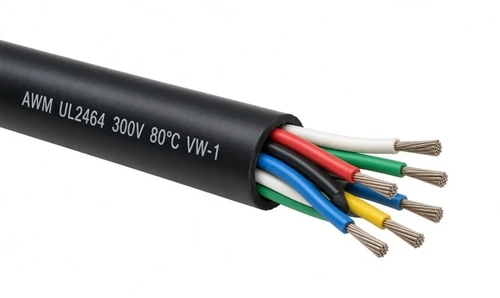
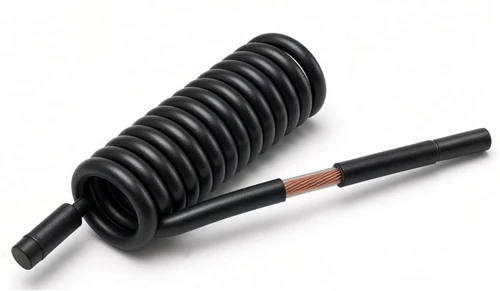
Multiple Conductor Cables are a seemingly small but an essential part inside electronic devices, industrial machinery and even your car. In short, it is a "highway" that combines several insulated wires, all within a single outer sheath. The design enables the simultaneous transmission of power, control signals or data, while considerably simplifying the wiring systems, thus increasing the reliability and safety of the equipment.
Why are Multiple Conductor Cable needed?
Imagine the tangled mess your computer would be if it were connected by hundreds of individual wires. That's the advantage of Multiple Conductor Cables:
Saves space and cost: Integrating multiple cables together takes up less space than individual cabling and significantly reduces installation time.
Strong anti-interference capability: Industrial environments are full of electromagnetic interference, and multi-core cables are usually equipped with shielding layers (such as aluminum foil or braided mesh), which can effectively protect signal integrity.
High durability: The outer sheath provides protection against moisture, chemicals, and physical abrasion.
Key Model Analysis: From UL20276 to UL2586
In the global wire and cable market, the UL (Underwriters Laboratories) standard has become more than a certificate document, it has become one of the global benchmarks to measure the safety, reliability and compliance of cables. Chinese manufacturers exporting to North America, German automated equipment being used in the United States… the UL mark is a "safety pass" accepted by customs, quality inspection agencies and end customers.
However, when you first encounter UL-certified Multiple Conductor Cables, you're likely to be bewildered by the long string of numbers on the cable-UL20276, UL2586, UL2661, UL2095… These numbers don't resemble model names; they're more like some kind of mysterious engineering code. What are the differences between them? Which one is truly what my equipment needs? For novice engineers, purchasing specialists, and even seasoned system integrators, facing this string of numbers often creates a sense of confusion: "They all clearly meet UL standards, but I don't know where to begin."
To help you more intuitively understand the technical meaning behind these numbers, instead of trying to memorize all the numbers at once, we can adopt a more efficient approach: select a few of the most representative UL models from the "Multiple Conductor Cables" family, which are most commonly found in the industrial and electronic fields, and analyze their structure, rated voltage, temperature range, shielding method, and typical application scenarios one by one.
UL20276: The "Blood Vessels" and "Nerves" of Electronic Devices
If you've ever disassembled a monitor, printer, or game console, you've likely seen UL20276. This is a Multiple Conductor Cable designed specifically for the internal wiring of electronic devices, typically rated at 30V and 80°C.
-
Flexible structure: It typically uses tin-plated or bare copper conductors and PVC insulation.
-
Shielding options: To meet the requirements of high-speed data transmission (such as USB or HDMI signals), it often adopts a twisted pair structure with aluminum foil shielding (AL Mylar) to effectively reduce crosstalk.
-
Application scenarios: UL20276 is an ideal choice for everything from printer internal cables to game console data connection cables.

UL2586: The "Hercules" of Industrial Automation
Unlike the low-voltage UL20276, UL2586 is a "powerhouse" designed specifically for harsh industrial environments. This Multiple Conductor Cable is rated for voltages up to 600V or even 1000V and is commonly used in applications requiring high power transmission and bending resistance.
-
High voltage withstand: Can withstand voltage tests of 1000V, suitable for motor drives or mains power connections.
-
Bending resistance: Commonly used in cable chain systems, it can maintain performance through millions of back-and-forth bends and is the "main artery" of robotic arms and automated production lines.
-
Full shielding: In order to work near strong interference sources such as frequency converters, UL2586 usually contains a double-layer "protective armor" of aluminum foil and braided mesh.

Other Models Overview
Besides the two mentioned above, the other numbers in the list also have their own focuses:
-
UL2661 and UL2095: Similar to UL20276, they are commonly used in electronic equipment, but differ slightly in insulation thickness or temperature rating to suit specific installation spaces.
-
UL2587: Often marked as "portable power cable", it is softer than UL2586 and suitable for power cords that are frequently moved.
-
UL20811: This is a relatively new standard number, usually corresponding to very thin coaxial or composite cables, often used for the internal core wires of high-performance data cables (such as Thunderbolt or high-specification USB cables).

How to choose the right Multiple Conductor Cable for you?
Choosing a model isn't actually that complicated; you just need to ask yourself three questions:
What voltage and current do you need?
If it is only for transmitting sensor signals (low voltage), a 30V cable like UL20276 is sufficient; if it is for powering a motor, a 300V or higher cable like UL2586 must be selected.
How harsh is the environment?
1. Risk of oil stains and wear? Choose an oil-resistant PVC sheath Multiple Conductor Cable (many UL20276 and UL2586 products have this characteristic).
2. Need to be bent frequently? Choose a Multiple Conductor Cable with a Continuous Flex design.
3. Are there frequency converters or large motors nearby? You must choose the shielded version.
Are there any safety regulations or restrictions?
If the equipment needs to be exported to the North American market, we must use UL-certified Multiple Conductor Cables. This is not only a performance requirement, but also a legal compliance requirement.
Summary
Multiple Conductor Cables are vital to modern electronic and electrical systems. From the delicate signal transmission of UL20276 in precision electronic equipment to the powerful power drive of UL2586 in industrial fields, these "UL numbers" are essentially the language of engineers, precisely defining what a cable can do and where it can be used. If you would like to learn more about Multiple Conductor Cables, please feel free to discuss it with us. If you are interested in purchasing Multiple Conductor Cables, please also contact us! Our factory manufactures many styles of Multiple Conductor Cables.