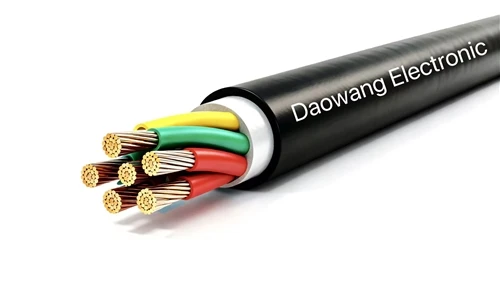
Have you ever wondered why smart speakers at home, printers in the office, and automated mechanical arms in factories can operate stably and convey information accurately? There is a "hidden army" behind all of this, working silently and tirelessly. They are multi-core cable wires - a group of "signal messengers" and "electricity carriers" who have "coordinated collaboration" deeply ingrained in their DNA.

Unlike a single-core cable with only one "offspring", a multi-core cable is like a well-trained team. Dozens of thin wire cores are neatly wrapped in the same outer sheath, each performing its own duty, neither competing for credit nor causing trouble. Some are responsible for transmitting electricity, some for transmitting signals, and some for ensuring safety. Today, we will focus on the "star players" among this "army" - several UL-certified multi-core cables. Each one has its own "exclusive skills" and is suitable for different "battlefield" requirements.
Let me first introduce a small piece of knowledge to you all: UL certification is not just an "honorary label" that can be slapped on casually. It is a safety certification issued by the American Insurance Laboratory, equivalent to issuing a "global universal safety pass" to the cable wires. Those who pass this certification must be able to withstand rigorous tests in terms of flame retardancy, insulation, and electrical performance. Now, let's bring out several "certified professionals" to show you!
Player 1: UL2726 - The "Flexible Little Genius" in Electronic Devices
If there is a "all-rounder" among multi-core cables, UL2726 is definitely one of them. Moreover, it is also a "flexible" type. This cable is mainly designed for internal wiring in electronic devices, with core numbers ranging from 2 to 7. It is like a compact "small team", and is particularly suitable for functioning in devices with limited space such as smartwatches, tablets, and small sensors.
Its "killer feature" is its remarkable flexibility and flame retardancy at low temperatures. At extremely low temperatures, it can retain its flexibility without shattering or becoming brittle. When it comes into contact with open flames, it can quickly extinguish a fire and prevent it from spreading within the device. Even more impressive is its capacity to handle twisted pair and multi-core wires. By carefully controlling the twisting pitch, it achieves a balance between flexibility and anti-interference performance, ensuring clearer signal transmission within the equipment without any "noise." When we use our phones to watch videos or work on tablets, the signal is constant and does not lag. This might be the result of UL2726's involvement.
Player 2: UL2464 - The "Durable Performer" for Industrial Environments
If UL2726 is good at "fine work", then UL2464 is good at "rough and strenuous tasks", and is the "mainstay" in industrial automation scenarios. This cable has extremely flexible core counts. The standard core count is 4 to 8, and it can be customized up to 36 cores, equivalent to a "large army", capable of simultaneously undertaking multiple signal and power transmission tasks. It is particularly suitable for automated production lines and CNC machines in factories, which are "multi-tasking" devices.
Its "armor" is exceptionally sturdy - a pure copper core wire combined with a PVC sheath, which is resistant to oil, wear and corrosion. Even when working in a workshop with a lot of oil stains and dust, it can maintain stable performance. Moreover, its shielding layer coverage rate can reach 98%, far exceeding the industry average. It's like putting a "Faraday cage" around the wire core, effectively blocking external electromagnetic interference and preventing internal signal leakage. This enables more precise movements of the robotic arm and a more stable operation of the production line. In addition, it complies with the ROHS environmental standard, being both safe and environmentally friendly. It can be regarded as a "a trustworthy player" in industrial settings.

Player 3: UL20549 - The "Safety Guardian" of Medical Equipment
Among all "battlefields", the requirements in the medical field are undoubtedly the most stringent. And UL20549 is precisely the "safety guardian" tailor-made for this field. This cable adopts a double-layer insulation structure, with its voltage resistance value being 40% higher than that of ordinary cables. It is like giving the wire core a "double-layer protective suit", which can effectively prevent leakage and ensure the safety of medical staff and patients.
Its core count standard is 3 to 6 cores, and it can be customized up to 24 cores. The twist ratio design reaches 20 times the diameter, which can minimize signal crosstalk to the greatest extent. In precision medical equipment such as nuclear magnetic resonance instruments and electrocardiogram machines, UL20549 is responsible for transmitting patients' vital sign signals and the control signals of the equipment. Every piece of data must be accurate without error, and every power transmission must be stable and reliable. After all, in the medical field, even a single signal deviation or a slight power fluctuation could affect the diagnosis results. And UL20549 uses its cutting-edge performance to safeguard this "life line".
Player 4: UL2517 - The "Best Value for Money" in Export Scenarios
If your requirement is for export and you are looking for a "cost-effective" solution, then UL2517 is definitely your best choice. This cable, like UL2464 and UL20549, is a UL-certified "authorized product". It meets all the fire resistance and insulation standards, complies with environmental protection standards such as RoHS and REACH, and comes with all the necessary technical documents for export, which can save you a lot of trouble during customs clearance.
Its standard core count is 2 to 4 cores, and it can be customized up to 12 cores. The twist ratio is designed at 16 times the diameter. It adopts a 45° diagonal twisting process, which reduces 15% of signal crosstalk compared to traditional methods. Whether it is used for home appliance exports or overseas assembly of small industrial equipment, it can perfectly fit the requirements. What's more surprising is that its cost-performance ratio is extremely high. Compared with imported similar products, it can save 25% to 30% of the procurement budget, and can be regarded as a model of "achieving great results with less money".


Apart from the above-mentioned four "star players", our company's UL20811, UL20167, UL2089, etc. are also "powerful" in the field of multi-core cables. For instance, UL2089 is mainly designed for high temperature and high pressure resistance, suitable for use in high-temperature industrial environments; UL11627 is good at resisting ultraviolet rays and having strong weather resistance, suitable for outdoor wiring; UL2919 is mainly focused on lightweight and integration, suitable for precision fields such as aerospace and high-end equipment.
In fact, the charm of multi-core cables lies in their "clear division of labor and efficient collaboration". Unlike single-core cables which "work alone", these multi-core cables achieve the "1+1>2" collaborative advantage to the fullest extent through reasonable core number combinations, precise twisting processes, and sturdy protective covers. The addition of UL certification further adds a "safety guarantee" to this collaboration, allowing them to be confidently "put into use" in various scenarios such as electronics, industry, healthcare, and outdoor applications.
The next time you use electronic devices or industrial machinery, why not think about whether there is such a "cable army" working behind the scenes? It is precisely these unremarkable multi-core cables that, through their "perseverance" and "professionalism", connect all aspects of our lives and work, and have become the most indispensable "invisible foundation" in modern technology.