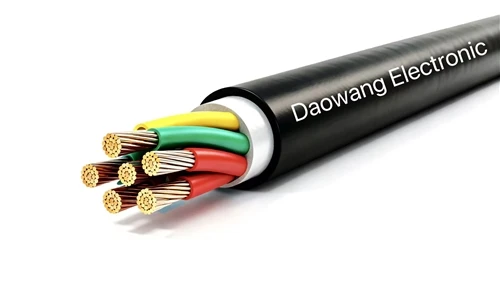
The cable you choose for your vehicle's electrical system can have a huge impact on safety, reliability and the life of the vehicle. The FL2G cable is the most commonly used cable for gasoline and alternative energy vehicles. It is specifically designed for automotive battery cables and offers excellent durability and flexibility at high temperatures. In this article we will describe the technical specifications, benefits, practical applications, and key considerations when choosing the FL2G cable, helping engineers and customers gain a better understanding of this important component.
Basic Introduction and Structure of FL2G Cable
FL2G cable is a German standard (GSB) automotive cable primarily used for battery lead wires. It features a single-core unshielded design with a high-purity copper conductor and silicone rubber insulation, giving it excellent heat resistance.
Key Structural Features:
-
Conductor: Bare copper or tin-plated coppe. The conductor uses a multi-strand stranded structure (e.g., 16/0.21, 50/0.26, etc.) to ensure good flexibility and conductivity.
-
Insulation: Silicone rubber material, providing excellent resistance to high temperatures, oil, fuels, acids, alkalis, and brake fluid.
-
Standards Compliance: ISO 6722 Class F (one of the highest temperature classes), some also comply with automotive industry standards such as LV 112 and ISO 19642.

Compared to other common automotive wiring harnesses (such as the FLRY series with PVC insulation), the biggest advantage of FL2G Cable is its high-temperature capability, with a long-term operating temperature of +200°C and even higher for short periods. This makes it particularly suitable for high-temperature environments such as engine compartments.
Technical specifications and performance parameters of FL2G cable
The FL2G cables are designed for a temperature range of -40°C to +200°C, offering excellent flexibility even at low temperatures and resistance to aging, cracking, and performance degradation at high temperatures. The cables are also flame-retardant, with good electrical insulation and mechanical strength.
The following is a typical specification table:
| Part NO. | Conductor | Insulation |
Max. Resistance at 20℃ |
Dielectric strength (VAC,30min) |
|||
| mm2 | NO./mm | Dia. mm |
Min.Thick. mm |
Max Dia. mm |
|||
| FL2G | 0.35 | 12/0.20 | 0.8 | 0.48 | 2 | 54.4 | 2000 |
| 0.5 | 16/0.20 | 0.92 | 0.48 | 2.3 | 37.1 | 5000 | |
| 0.75 | 24/0.20 | 1.14 | 0.48 | 2.5 | 24.7 | 5000 | |
| 1 | 32/0.20 | 1.31 | 0.48 | 2.7 | 18.5 | 5000 | |
| 1.5 | 30/0.25 | 1.58 | 0.48 | 3 | 12.7 | 5000 | |
| 2 | 30/0.30 | 1.83 | 0.48 | 3.3 | 9.42 | 5000 | |
| 2.5 | 50/0.25 | 2.04 | 0.56 | 3.6 | 7.6 | 5000 | |
| 3 | 45/0.30 | 2.3 | 0.56 | 4.1 | 6.15 | 5000 | |
| 4 | 56/0.30 | 2.6 | 0.64 | 4.4 | 4.71 | 5000 | |
| 5 | 78/0.30 | 2.9 | 0.64 | 4.9 | 3.94 | 5000 | |
| 6 | 84/0.30 | 3.18 | 0.64 | 5.0 | 3.14 | 5000 | |
| 10 | 80/0.40 | 4.23 | 0.8 | 6.5 | 1.82 | 5000 | |
| 16 | 126/0.40 | 5.61 | 0.8 | 8.3 | 1.16 | 5000 | |
| 25 | 194/0.40 | 7.0 | 1.04 | 10.4 | 0.743 | 5000 | |
| 35 | 276/0.40 | 8.09 | 1.04 | 11.6 | 0.527 | 5000 | |
| 50 | 396/0.40 | 9.7 | 1.2 | 13.5 | 0.368 | 5000 | |
| 70 | 557/0.40 | 11.4 | 1.2 | 15.5 | 0.259 | 5000 | |
| 95 | 757/0.40 | 13.26 | 1.28 | 18.0 | 0.196 | 5000 | |
| 120 | 969/0.40 | 15.0 | 1.28 | 19.7 | 0.153 | 5000 | |
The core advantages of FL2G cables
1. Superior High-Temperature Performance: In engine compartment environments where temperatures can reach 150-200°C, ordinary PVC cables easily soften or decompose, while FL2G Cable can operate stably for over 3000 hours (some specifications), significantly reducing the risk of failure.
2. Strong Chemical Stability: Resistant to oil, fuels, brake fluid, and organic media, suitable for complex automotive operating conditions.
3. High Flexibility: Maintains good bending performance even at -40°C, facilitating installation and wiring.
4. Safe and Environmentally Friendly: Complies with RoHS, REACH, and other standards; low halogen content and good flame retardant properties.
5. Long Lifespan: Excellent anti-aging capabilities, reducing maintenance costs.
Compared to thin-walled cables (such as the FLR series), the FL2G is a thick-walled design, making it more suitable for high-current, high-temperature battery lead scenarios.
FL2G Practical Application Cases

Case 1: Upgrading the Battery System of a Traditional Gasoline Vehicle
European car manufacturer used FL2G 16mm² and 25mm² cables for positive and negative battery leads in engine compartment. The original PVC cables have experienced insulation aging and leakage after two years of use in high-temperature environment. The vehicle pass rate for high temperature testing (+180°C continuous cycling) increased by 95% after replacement with FL2G cables. The reliability of the battery connection and the related failure rate during the warranty period was greatly improved by 70%. This directly reduces the risks and after-sales costs of recall.

Case 2: Auxiliary Wiring for High-Voltage Battery Packs in New Energy Vehicles
In the field of new energy vehicles, the main high-voltage cables are different, but FL2G is often used for low-voltage auxiliary power supplies, sensor power supplies, or BMS connection lines.A Chinese new energy vehicle manufacturer used FL2G 6mm² and 10mm² cables in the high-temperature area near the motor controller.The cables have to endure the high temperature vibration environment of the engine compartment, and have to go through extreme temperature cycling tests (-40°C~+200°C) and salt spray corrosion tests, ensuring stable vehicle operation in cold and high-altitude regions.

Case Study 3: Heavy Commercial Vehicles and Construction Machinery
Large vehicles such as trucks and excavators require battery leads that can handle high currents and harsh vibrations. A construction machinery company used FL2G 35-70mm² large-section cables to connect the starter motors and generators. The flexibility and abrasion resistance of the silicone rubber proved effective in preventing cable breakage or damage of the insulation in prolonged vibrations, which increased the overall service life of the equipment and the maintenance intervals from 6 months to 18 months.
These cases demonstrate that FL2G is not only suitable for passenger cars but also widely used in commercial vehicles, racing cars, and special-purpose vehicles.
Selection and Installation Precautions
In selecting a conductor, keep in mind the following:
1. Cross section area. According to load current (refer to automotive electrical design specifications).
2. Color coding: Red (positive) and black (negative) are most common, but other colors can be customized.
3. Tin plating vs. bare copper: Tin-plated conductors are better at resisting corrosion, and are suitable for use in humid or salt spray environments.
4. Supplier Certification: Select manufacturers certified by automotive quality systems, such as IATF 16949, to ensure consistency across batches.
During installation, keep an eye on the minimum bending radius, avoid the sharp edge to scratch the insulation layer and use the suitable clamp to avoid vibration and wear. In new energy vehicles, you also need to stay away from high-voltage cables.
Summary
With the accelerating electrification of automobiles, the demand for high-temperature, durable cables is increasing daily. FL2G, as a mature high-temperature solution, still has significant potential in the auxiliary systems of hybrid and pure electric vehicles. In the future, similar cables will evolve further by incorporating lightweight design (such as the aluminum conductor variant FLAL2G) and intelligent monitoring technology.
FL2G cables, with their reliable high-temperature performance and comprehensive protection, have become the preferred choice for automotive battery leads. Whether for OEMs or aftermarket enthusiasts, choosing FL2G adds an extra layer of safety to electrical systems.