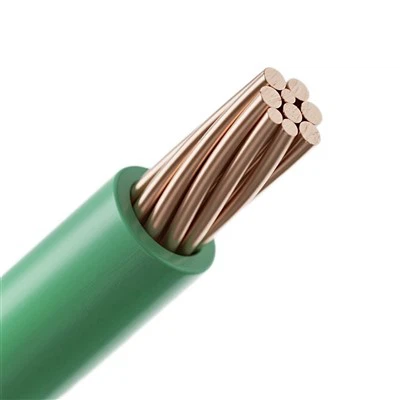
EV Charging Cables For Electric Vehicles are used to connect the charging port to the battery, link the cells inside the battery pack, and carry power between the battery and the motor or other major components. Basically, they're the main arteries for moving electricity around the car. Because these cables sit in a really tough environment - extreme temperatures, constant vibration, potential exposure to moisture and chemicals - EV Charging Cables For Electric Vehicles have to meet very strict performance standards. The insulation and materials need to be extremely durable and safe, especially since they're handling high voltage.
Feature
-
Rated voltage:450 or 750V AC / 1000V DC
-
Rated temperature:90℃
-
Ambient temperature:-40℃~+50℃
-
Material:XLPE or TPE
-
Sheath:XLPE,TPE or PU
-
Stranded annealed bare copper wire or tinned copper wire
-
Standard:GB/T 33594-2017

Application
Core transmission of high-voltage power systems
EV Charging Cables For Electric Vehicles carry three-phase power (U, V, W phases) from the battery pack to the motor controller. They're built to handle really high currents - sometimes several hundred amps. For example, the wiring harness in a Tesla Model 3 is rated for up to 500A. EV Charging Cables For Electric Vehicles also connect the high-voltage distribution box (PDU) to other components like the air conditioning compressor, making sure everything gets the power it needs.
Vehicle-mounted assistance and control scenarios
Low-voltage wiring works like the car's nervous system. It connects the main control modules to things like door locks, window motors, lights, and all the other small electrical bits around the vehicle. The BMS sampling lines constantly keep an eye on each battery cell's voltage and temperature. For important signals, like the CAN bus that talks to ADAS sensors and other electronics, manufacturers usually use twisted-pair cables. This helps reduce electrical noise and keeps the communication stable and reliable.
The charging system is fully adaptable to all scenarios
EV Charging Cables For Electric Vehicles are used at home chargers, residential stations, and hotels. They deliver power to the car's on-board charger, which then converts it for the battery. On the other hand, DC fast-charging cables can handle much higher power. Some of them even come with built-in liquid cooling to manage the serious heat generated during fast charging. EV Charging Cables For Electric Vehicles are also designed for emergency or portable use, and they're built tough - resistant to oil, abrasion, and everyday wear and tear.


Technical Parameters
Insulation thickness and conductor resistance

EVDC-S90S90S90 ,EVDC-YJYJYJ & EVDC-S90S90PS90,EVDC-YJYJPY

EVDC-S90UU,EVDC-YJUU & EVDC-S90UPU,EVDC-YJUPU

EV-S90S90S90,EV-YJYJYJ & EV-S90S90PS90,EV-YJYJPYJ

FAQ
Q: Are you a manufacturer?
A: We are a manufacturer located in Suzhou, Jiangsu, China. Our company's sales and service network covers the whole world to guarantee the professionalism of products and the satisfaction of customers' after-sales service.
Q: Are your wires ROHS compliant?
A: All our wires are ROHS compliant.
Hot Tags: ev charging cables for electric vehicles, China ev charging cables for electric vehicles manufacturers, suppliers, factory